

FDA Panel Hears Recommendations on Contact Lens Solutions
The Food and Drug Administration (FDA) Ophthalmic Devices Panel of the Medical Devices Advisory Committee met on June 10, 2008 to consider recommendations on contact lens care product development including preclinical testing and clinical performance measures, and labeling for contact lenses and lens care products. Among the issues reviewed were:
- Changes from “no rub" to “rub and rinse” labeling
- Addition of "discard dates" on contact lenses to indicate when a product should be disposed of after it's opened
- Expanding preclinical testing protocols to include testing solutions against more types of bacteria and fungi including Acanthamoeba
- Recommendations on frequent replacement of contact lens cases
- Stronger warnings against reuse of contact lens solutions
The panel also considered information offered by companies and others such a joint statement issued by The American Academy of Ophthalmology, the Contact Lens Association of Ophthalmologists, the Cornea Society and the American Society of Cataract and Refractive Surgery. A complete text of their recommendations is available at: http://aao.org/upload/joint_CL_recommendationsL.pdf. Representatives of the American Academy of Optometry Section on Cornea and Contact Lenses and the American Optometric Association Contact Lens and Cornea Section also addressed the panel. Comments issued by Advanced Medical Optics urged a “rub and rinse" regimen be required.
The FDA is likely to adopt the panel’s recommendations, though it is not required to do so. When the panel recommendations and transcript are posted to the FDA website, we will provide the link to our readers.
- Changes from “no rub" to “rub and rinse” labeling
- Addition of "discard dates" on contact lenses to indicate when a product should be disposed of after it's opened
- Expanding preclinical testing protocols to include testing solutions against more types of bacteria and fungi including Acanthamoeba
- Recommendations on frequent replacement of contact lens cases
- Stronger warnings against reuse of contact lens solutions
The panel also considered information offered by companies and others such a joint statement issued by The American Academy of Ophthalmology, the Contact Lens Association of Ophthalmologists, the Cornea Society and the American Society of Cataract and Refractive Surgery. A complete text of their recommendations is available at: http://aao.org/upload/joint_CL_recommendationsL.pdf. Representatives of the American Academy of Optometry Section on Cornea and Contact Lenses and the American Optometric Association Contact Lens and Cornea Section also addressed the panel. Comments issued by Advanced Medical Optics urged a “rub and rinse" regimen be required.
The FDA is likely to adopt the panel’s recommendations, though it is not required to do so. When the panel recommendations and transcript are posted to the FDA website, we will provide the link to our readers.
Vistakon to Introduce Acuvue Oasys for Astigmatism
Vistakon, Division of Johnson & Johnson Vision Care, Inc., announced plans to introduce Acuvue Oasys Brand Contact Lenses for Astigmatism. The lens will soon be available at some U.S. eye care professionals’ offices, with distribution expected to grow through the coming months.
Acuvue Oasys for Astigmatism combines the Accelerated Stabilization Design (ASD) technology of Acuvue Advance Brand Contact Lenses for Astigmatism, with senofilcon A, the new generation silicone hydrogel material of Acuvue Oasys contact lenses. Per Vistakon, the lens also features Hydraclear Plus, the improved formulation of the unique Hydraclear technology that combines high performance base materials with a moisture-rich wetting agent.
“Acuvue Oasys for Astigmatism brings together the best features of two of the leading contact lenses on the market,” says Sheila Hickson-Curran, Director, Medical Affairs, Vistakon. “It offers outstanding visual acuity and fit for astigmatic patients, providing clear and consistent vision and comfort throughout the day. With this lens, wearers do not have to compromise vision.”
Acuvue Oasys for Astigmatism combines the Accelerated Stabilization Design (ASD) technology of Acuvue Advance Brand Contact Lenses for Astigmatism, with senofilcon A, the new generation silicone hydrogel material of Acuvue Oasys contact lenses. Per Vistakon, the lens also features Hydraclear Plus, the improved formulation of the unique Hydraclear technology that combines high performance base materials with a moisture-rich wetting agent.
“Acuvue Oasys for Astigmatism brings together the best features of two of the leading contact lenses on the market,” says Sheila Hickson-Curran, Director, Medical Affairs, Vistakon. “It offers outstanding visual acuity and fit for astigmatic patients, providing clear and consistent vision and comfort throughout the day. With this lens, wearers do not have to compromise vision.”
Contact Lens Spectrum to Host the Global Specialty Lens Symposium
Contact Lens Spectrum and the Health Care Conference Group will host the Global Specialty Lens Symposium (GSLS), January 15-18, 2009, at Bally’s Hotel and Casino in Las Vegas, Nevada. The GSLS will span three and one-half days and include presentations on the latest techniques and technologies for the successful management of ocular conditions using today’s specialty contact lenses. GSLS will provide insights from experts from around the globe and hands-on access to the most current products available. The comprehensive meeting, including free paper and poster presentations, will offer information for vision care professionals in all disciplines. The program will be accredited for continuing education under COPE, NCLE and JCAHPO, offering 17+ credit hours.
The GSLS will share a similar format and many of the renowned speakers from its successful predecessors, the well-received Global Orthokeratology Symposium and Global Keratoconus Congress, both of which attracted an average of 500 participants from around the world.
Those interested in attending and/or submitting free papers or posters to the GSLS can visit www.GSLSymposium.com for more information or to register for this meeting. Companies interested in exhibiting should contact Sean Casey at 732-483-4302 or caseys@lwwvisioncare.com.
The GSLS will share a similar format and many of the renowned speakers from its successful predecessors, the well-received Global Orthokeratology Symposium and Global Keratoconus Congress, both of which attracted an average of 500 participants from around the world.
Those interested in attending and/or submitting free papers or posters to the GSLS can visit www.GSLSymposium.com for more information or to register for this meeting. Companies interested in exhibiting should contact Sean Casey at 732-483-4302 or caseys@lwwvisioncare.com.
A New Way to See the World
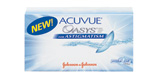
Research suggests that many toric contact lens wearers are not satisfied with their visual performance. Make your patients’ experience satisfying with new ACUVUE® OASYS™ Brand Contact Lenses for ASTIGMATISM. The latest in toric lenses combines HYDRACLEAR® Plus for all-day comfort with Accelerated Stabilization Design for crisp, clear vision. To learn more, go to: jnjvisioncare.com.
Important Safety Information
--ADVERTISING
Important Safety Information
--ADVERTISING
Ohio State Honors Holden at Spring Commencement
An honorary Doctor of Science degree was presented to Brien A. Holden at the Ohio State University's spring 2008 commencement. Brien Holden is Scientia Professor in the School of Optometry and Vision Science at the University of New South Wales in Australia. He is CEO of the Institute for Eye Research and a director and deputy CEO of the government's Vision Cooperative Research Centre.
Professor Holden founded the Cornea and Contact Lens Research Unit in 1976 at the University of New South Wales, doing cutting-edge research on corneal physiology and new contact lens materials and designs. The unit has grown into the Institute for Eye Research. A graduate of the University of Melbourne, Professor Holden holds a doctorate from The City University in London. He has published more than 300 peer-reviewed articles on his research.
His international work includes serving as chair and CEO of the International Centre for Eyecare Education; global chair of Optometry Giving Sight; chair of the Refractive Error Working Group of the World Health Organization; and board member of the International Agency for Prevention of Blindness and its Vision 2020: Right to Sight Global Initiative. In addition, he serves as deputy co-chair of Vision 2020 Australia and chair of the board of management of VisionCare NSW.
Professor Holden founded the Cornea and Contact Lens Research Unit in 1976 at the University of New South Wales, doing cutting-edge research on corneal physiology and new contact lens materials and designs. The unit has grown into the Institute for Eye Research. A graduate of the University of Melbourne, Professor Holden holds a doctorate from The City University in London. He has published more than 300 peer-reviewed articles on his research.
His international work includes serving as chair and CEO of the International Centre for Eyecare Education; global chair of Optometry Giving Sight; chair of the Refractive Error Working Group of the World Health Organization; and board member of the International Agency for Prevention of Blindness and its Vision 2020: Right to Sight Global Initiative. In addition, he serves as deputy co-chair of Vision 2020 Australia and chair of the board of management of VisionCare NSW.
Allaboutvision.Com Offers Premium Directory Listing for World Sight Day Challenge Participants
AllAboutVision.com will offer a premium listing in its Eye Care Practitioner Directory for all optometrists who sign up for Optometry Giving Sight’s World Sight Day Challenge.
The World Sight Day Challenge invites all optometrists to donate their eye exam fees to Optometry Giving Sight on World Sight Day (October 9, 2008) to help fund projects that will provide vision care, local training and infrastructure development in countries that lack basic eye care services.
Current and new regular donors are also eligible for the premium listing, which will include practice name, street address, telephone number, website link and an icon denoting the practice as an Optometry Giving Sight donor. To take advantage of this special offer, optometrists just need to sign up for the World Sight Day Challenge and link their practice website to the AllAboutVision.com website. The website served 8.2 million visitors in 2007.
Optometrists can register for the Challenge at www.givingsight.org or by calling 1-888-OGS-GIVE. To link to AllAboutVision.com visit: http://www.allaboutvision.com/ecp/.
The World Sight Day Challenge invites all optometrists to donate their eye exam fees to Optometry Giving Sight on World Sight Day (October 9, 2008) to help fund projects that will provide vision care, local training and infrastructure development in countries that lack basic eye care services.
Current and new regular donors are also eligible for the premium listing, which will include practice name, street address, telephone number, website link and an icon denoting the practice as an Optometry Giving Sight donor. To take advantage of this special offer, optometrists just need to sign up for the World Sight Day Challenge and link their practice website to the AllAboutVision.com website. The website served 8.2 million visitors in 2007.
Optometrists can register for the Challenge at www.givingsight.org or by calling 1-888-OGS-GIVE. To link to AllAboutVision.com visit: http://www.allaboutvision.com/ecp/.
Abstract: Long-Term Clinical Outcomes for Overnight Corneal Reshaping in Children and Adults
The researcher retrospectively evaluated outcomes of overnight corneal reshaping (OCR) in children aged 12 years or younger compared to children older than 12 years and adults at one practice to establish the efficacy and safety of OCR during a period of 51 months.
Examination records of OCR patients were reviewed for pretreatment data, including manifest refraction, keratometric readings, topography, corneal staining, and age at beginning OCR. Post treatment records were reviewed for manifest refraction, unaided visual acuity, keratometric readings, topography, corneal staining, adverse events, and duration of OCR lens wear.
Records of 296 OCR patients were evaluated. One hundred fifty-four (52.0%) patients were 12 years old or younger. Sixty-eight percent of all patients in the study were Asian, and almost 95% of the patients aged 12 years or younger were Asian. The patients aged 12 years or younger had a mean original spherical equivalent refractive error of -3.50 +/- 1.50 diopters (D). The patients older than 12 years had a mean original spherical equivalent refractive error of -3.20 +/- 1.50 D. Refractive changes were similar between the group aged 12 years or younger and the group older than 12 years (3.30 +/- 1.40 D vs. 3.10 +/- 1.40 D) (P=0.14). The mean unaided, binocular logMAR visual acuity was 0.03 +/- 0.06 (i.e., 20/20) for the group aged 12 years or younger and 0.02 +/- 0.07 (i.e., 20/20) for the group older than 12 years. There were three adverse events during the study that did not result in a loss of best-corrected visual acuity. A total of 507 patient-years of wear were represented in the study.
The author concluded that OCR resulted in comparable safety and efficacy in temporarily reducing myopia for children younger than 12 years as it is for children older than 12 years and adults.
Lipson MJ. Long-term clinical outcomes for overnight corneal reshaping in children and adults. Eye Contact Lens. 2008 Mar;34(2):94-9.
Examination records of OCR patients were reviewed for pretreatment data, including manifest refraction, keratometric readings, topography, corneal staining, and age at beginning OCR. Post treatment records were reviewed for manifest refraction, unaided visual acuity, keratometric readings, topography, corneal staining, adverse events, and duration of OCR lens wear.
Records of 296 OCR patients were evaluated. One hundred fifty-four (52.0%) patients were 12 years old or younger. Sixty-eight percent of all patients in the study were Asian, and almost 95% of the patients aged 12 years or younger were Asian. The patients aged 12 years or younger had a mean original spherical equivalent refractive error of -3.50 +/- 1.50 diopters (D). The patients older than 12 years had a mean original spherical equivalent refractive error of -3.20 +/- 1.50 D. Refractive changes were similar between the group aged 12 years or younger and the group older than 12 years (3.30 +/- 1.40 D vs. 3.10 +/- 1.40 D) (P=0.14). The mean unaided, binocular logMAR visual acuity was 0.03 +/- 0.06 (i.e., 20/20) for the group aged 12 years or younger and 0.02 +/- 0.07 (i.e., 20/20) for the group older than 12 years. There were three adverse events during the study that did not result in a loss of best-corrected visual acuity. A total of 507 patient-years of wear were represented in the study.
The author concluded that OCR resulted in comparable safety and efficacy in temporarily reducing myopia for children younger than 12 years as it is for children older than 12 years and adults.
Lipson MJ. Long-term clinical outcomes for overnight corneal reshaping in children and adults. Eye Contact Lens. 2008 Mar;34(2):94-9.
Editor's Commentary: Proper Contact Lens Care Starts Here
I was not present at the FDA panel meeting this past week but it appears there were no major bombshells. It is clear that industry, representatives from eye care organizations, and eye care experts want what is best for our patients’ eye health. I’m no expert in solution testing protocol but do feel that now is the time to re-evaluate our testing protocol especially with respect to scenarios that commonly occur in daily living. A collated and agreed upon set of contact lens care guidelines by all major eye care organizations to promote healthy contact lens care practices for our patients would be a welcome outcome of this meeting. Whether no-rub on our contact lens care packaging exists in the future or not, this will be an uphill battle as many consumers have well established care habits that won’t be easily changed. No matter what the outcomes of this panel discussion, clinicians and staff must continue to do their part and remain vigilant on educating and discussing proper contact lens care at each and every contact lens visit.
Carla Mack, O.D., M.B.A., F.A.A.O.
Carla Mack, O.D., M.B.A., F.A.A.O.
This month at www.siliconehydrogels.org: the latest advancements in silicone hydrogel lenses, complications relating to over wear of hydrogel lenses, the growing popularity of silicone hydrogel lenses on a university campus, and part one of our 2007 AAO update.
Report adverse contact lens reactions here: http://www.accessdata.fda.gov/scripts/medwatch/ or call (800) FDA-1088.
Report possible grievances related to the Fairness to Contact Lens Consumers Act or associated Contact Lens Rule at: https://www.ftccomplaintassistant.gov/.
Report possible grievances related to the Fairness to Contact Lens Consumers Act or associated Contact Lens Rule at: https://www.ftccomplaintassistant.gov/.
Send your favorite tips to tips@cltoday.com. Your tip may be selected as best of the month. See http://www.CLToday.com for details. Please include your full name, degree or title and city/state/country.
For more information on Contact Lenses Today including archives of previous issues or to subscribe to this newsletter, please visit our website at www.cltoday.com.
For the latest articles on contact lenses, important clinical information and helpful tools related to the contact lens practice visit the Contact Lens Spectrum website at www.clspectrum.com.
Contact Lenses Today and CLToday are registered trademarks of Lippincott, Williams and Wilkins, Inc. ©2008 by Wolters Kluwer Health, Lippincott, Williams and Wilkins VisionCare Group, 1300 Virginia Drive, Suite 400, Fort Washington PA 19034, phone 215-643-8000